Versioning AI Workflows: Why Immutability Matters
Software engineers understand version control for code. The idea that any previous state of your codebase is recoverable, that you can see who changed what and when, and that you can roll back a bad deployment in minutes — these are table stakes for modern development.
AI workflow definitions deserve the same treatment. Most teams do not apply it. This post explains why it matters and what good workflow versioning looks like.
The problem with mutable workflow definitions
When a workflow definition can be edited in place — a quick fix to the prompt, a new step added, a condition tweaked — several things become impossible:
You cannot understand historical runs. A run that completed three weeks ago was executed against a different version of the workflow than the one that exists today. Without versioning, you have no way to see what the workflow looked like when that run happened. Debugging historical behaviour becomes impossible.
You cannot safely experiment. If you want to test a modified workflow, you have to either overwrite the production definition (risky) or maintain a separate copy manually (error-prone). There is no clean way to run the old and new versions side by side.
You cannot roll back. A workflow change that causes a regression has no clear remediation path. You have to manually reconstruct the previous version from memory or a backup.
Compliance is harder. Regulated industries require audit trails for automated decision-making systems. "What logic was applied when this decision was made?" cannot be answered without a versioned record of workflow definitions.
What immutable versioning looks like
The right model for workflow versioning borrows from how databases handle schema migrations and how container registries handle image versions:
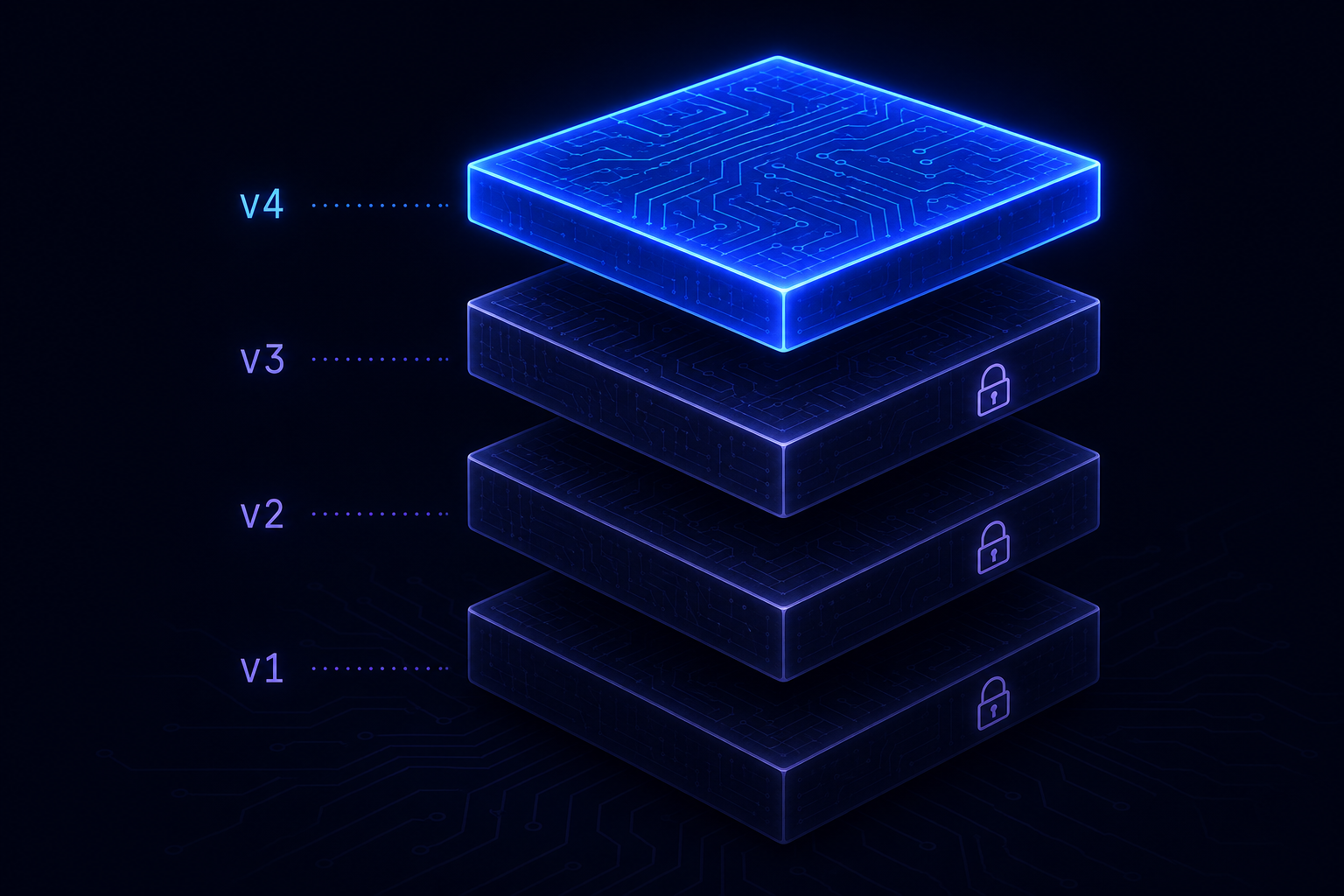
Each deployment creates a new version. When you update a workflow, you get version 2, 3, 4. The previous version is not modified. It remains accessible and executable.
Runs are stamped with a version. Every run records which version of the workflow it executed. Historical runs are permanently linked to the workflow definition that produced them.
Side-by-side execution is possible. You can run version 2 in production while routing a subset of traffic to version 3 for testing. Both run concurrently without interference.
Rollback is a version switch. A bad deployment is resolved by activating the previous version. No reconstruction, no guesswork.
Deterministic replay
Immutable versioning enables something even more powerful: deterministic replay. With the workflow definition and the original input preserved, you can re-execute a historical run exactly as it happened. This has two important applications:
Debugging. Reproduce a production failure in isolation without affecting live traffic. The same inputs, the same workflow version, the same execution path.
Regression testing. When you ship version 3 of a workflow, replay a sample of historical production runs through it. Compare the outputs to what version 2 produced. Differences are a signal to investigate before activating the new version.
This is the equivalent of unit tests for AI workflows, grounded in real production data.
Version strategy in practice
A practical versioning approach for production AI workflows:
-
Treat workflow definitions as code artifacts. They live in version control alongside your application code. A PR that changes a workflow definition goes through the same review process as a code change.
-
Deploy new versions, never edit active ones. Make it a policy that production workflow definitions are immutable once active. Changes create new versions.
-
Keep N previous versions active. Maintain the last two or three versions in an executable state so that in-flight runs on older versions can complete normally after a deployment.
-
Tie version activation to your deployment pipeline. A workflow version is activated when a deployment succeeds, and rolled back when a deployment fails — same as any other deployable artifact.
The long-term value
The teams that invest in workflow versioning early are the ones that can move fast six months later. They can ship workflow changes confidently because they know exactly what changed, what the previous state was, and how to recover if something goes wrong.
The teams that skip it accumulate risk invisibly. Every undocumented change is a potential incident they cannot fully diagnose when it surfaces.
Versioning is boring. It is also exactly the kind of foundational infrastructure that determines whether AI agents stay in production long-term or get quietly retired because nobody can figure out what they are doing anymore.
AgentRuntime stores immutable workflow versions, stamps every run with the version that executed it, supports side-by-side execution of multiple versions, and enables deterministic replay for historical runs. Learn more in the documentation or join the waitlist.