How to Build a Multi-Agent System That Actually Works
Single-agent systems have limits. A workflow that asks one agent to research a topic, draft content, fact-check it, optimize it for SEO, and generate metadata is asking one context window to hold too many concerns simultaneously. Quality suffers.
Multi-agent systems — an orchestrator that coordinates specialist sub-agents, each focused on one task — are the production answer for complex AI workflows. They are also significantly harder to build reliably than single-agent systems.
The orchestrator pattern
The canonical multi-agent architecture separates concerns into two layers:
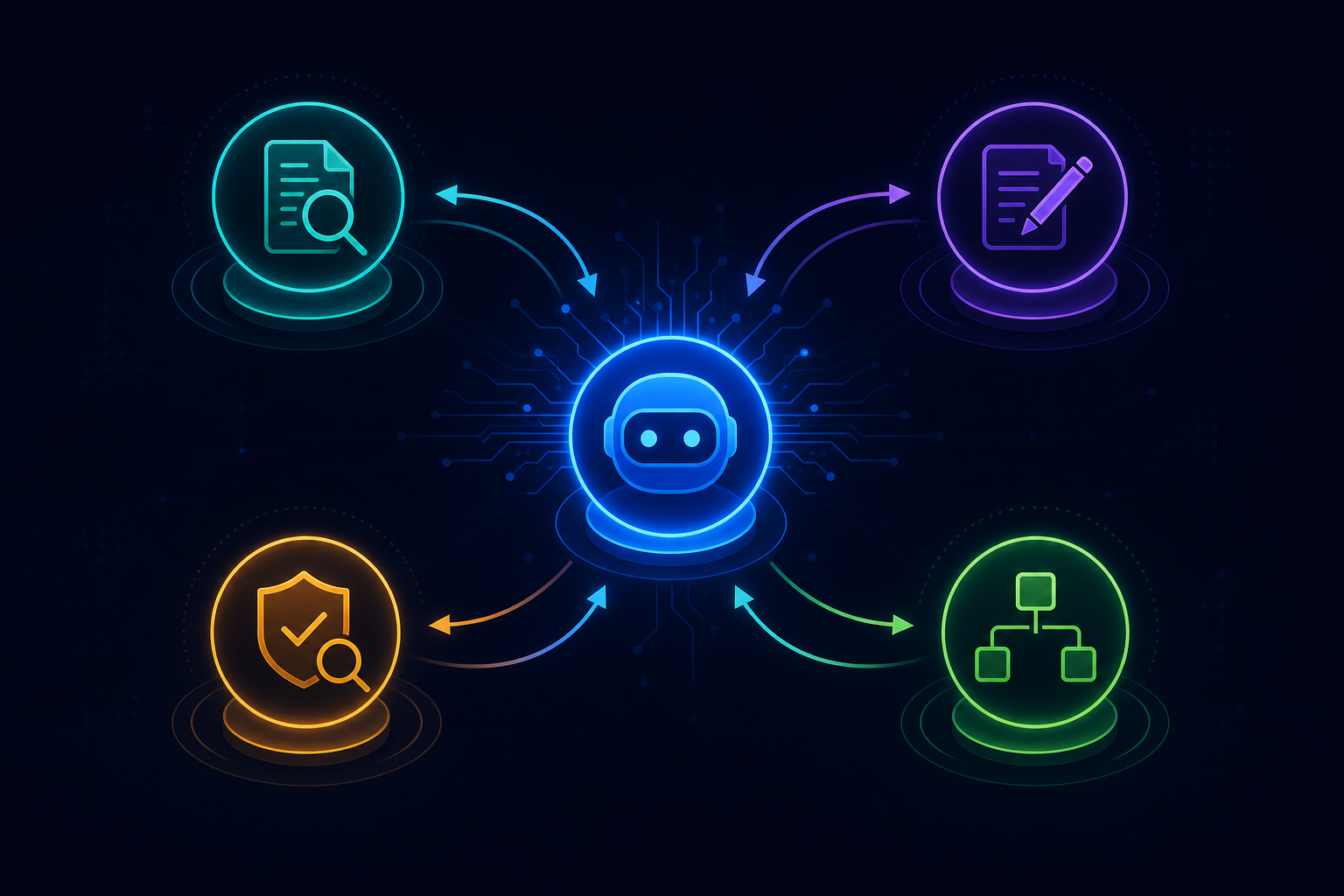
Orchestrator: decides what needs to happen next, delegates tasks to specialist agents, aggregates results, and manages the overall workflow state. The orchestrator does not do the actual work — it coordinates.
Specialist agents: each focused on a narrow, well-defined task. A research agent. A writing agent. A fact-checking agent. A classification agent. Each has a focused prompt, the right context for its task, and clear input/output contracts.
The orchestrator's job is routing and coordination, not execution. Keeping this separation clean is the difference between a maintainable multi-agent system and an entangled mess.
Communication patterns between agents
Agents in a multi-agent system can communicate in several ways, with different trade-offs:
Sequential: agent A completes, its output becomes agent B's input. Simple to reason about, no concurrency, each step blocks on the previous.
Parallel fan-out: the orchestrator dispatches multiple agents simultaneously and waits for all to complete before aggregating. Better throughput, more complex failure handling — what happens when one specialist fails while others succeed?
Dynamic dispatch: the orchestrator decides at runtime which specialist to call based on intermediate results. A research agent's output may or may not trigger a fact-checking agent depending on whether the content makes claims that need verification. This is the most flexible pattern and the hardest to debug.
The shared state problem
Multi-agent systems need shared state that all agents can read from and write to. Without it, each agent operates on a local copy of the world and the orchestrator must shuttle information between them explicitly — which is error-prone and verbose.
The shared state store needs to be:
- Consistent: an agent that reads state sees the latest committed writes
- Typed: agents write structured outputs, not raw strings, so the orchestrator can reason about them
- Auditable: the full state at each step is inspectable for debugging
Failure isolation
The key reliability property of a well-designed multi-agent system: a failure in one specialist does not necessarily fail the entire workflow. The orchestrator can detect the failure, decide whether to retry, use a fallback specialist, or continue with partial results.
This requires the orchestrator to treat specialist agents as potentially unreliable services, not as internal function calls. Timeouts, retry policies, and fallback behavior should be explicit in the orchestrator's coordination logic.
When not to use multiple agents
Multi-agent systems add coordination overhead. Before decomposing into multiple agents, ask whether a single well-structured prompt with chained reasoning achieves the same result. For tasks where the sub-tasks are not truly independent — where the research informs the writing in ways that are hard to capture in a structured handoff — a single agent with a carefully structured prompt may actually produce better output.
Multi-agent systems shine when the sub-tasks are large, genuinely independent, benefit from specialization, and when the coordination overhead is worth the modularity it buys.
AgentRuntime's nested run model supports multi-agent architectures natively: the orchestrator run spawns specialist sub-runs, each with its own trace, state, and failure domain, with results aggregated back to the parent run. Join the waitlist for early access.