AI Agents for E-Commerce: Automating Order Management
Order management is e-commerce operations in miniature: a customer places an order, inventory is reserved, the order is fulfilled, the customer is notified at each stage, exceptions are handled. At low volume, a human team handles this. At scale, the volume of orders, exceptions, and customer inquiries exceeds what manual processes can handle without significant headcount.
AI agents slot into order management as exception handlers and decision makers — not replacing the deterministic parts of the workflow, but handling the cases that require judgment.
Where AI belongs in order management
Not everything in order management needs AI. Inventory reservation, shipping label generation, payment processing — these are deterministic operations handled by existing systems. AI adds value where judgment is required:
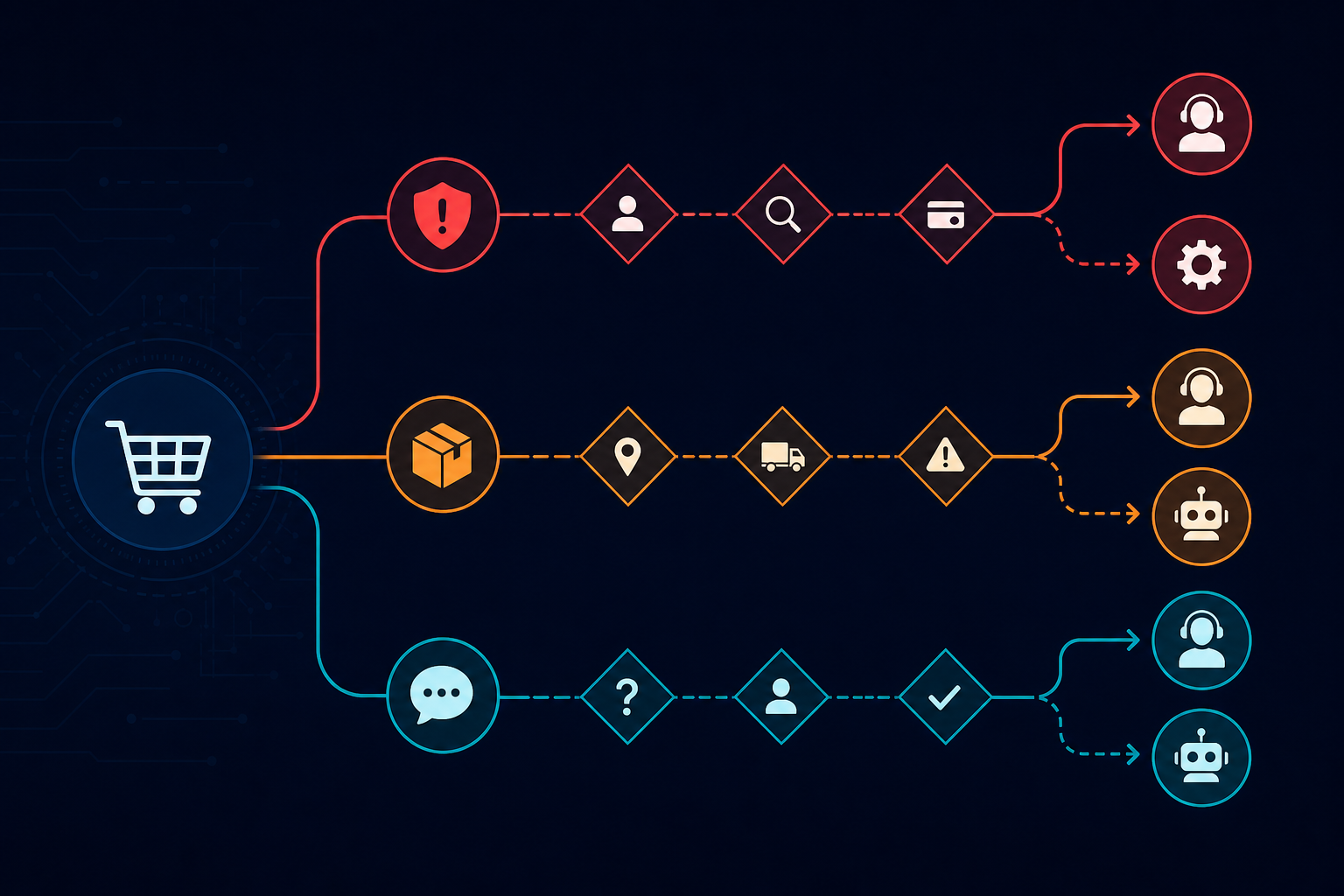
Fraud detection and review: flagging unusual orders for review before fulfillment. Rule-based fraud detection catches known patterns; an LLM-assisted review can catch novel patterns that the rules miss, using signals like order velocity, address consistency, device fingerprint correlation, and behavioral anomalies.
Exception handling: orders that cannot be auto-fulfilled — out-of-stock items, payment declined but customer still engaged, address validation failures, customs documentation requirements. Each exception class has a best-path resolution that the AI can evaluate and execute.
Customer inquiry triage: "Where is my order?" inquiries can be answered by pulling order status and shipping carrier data. "My order arrived damaged" inquiries need a refund or replacement decision workflow. Classifying and routing inquiries is a high-volume, repetitive task that is well-suited to AI.
Returns processing: classifying return reasons, evaluating return eligibility against policy, initiating refunds or replacements. A return that involves a broken item, a high-value customer, and an unusual request pattern requires judgment that rule-based systems cannot provide.
The fraud review workflow
A production fraud review workflow:
- Receive order data including all available signals
- Run through deterministic rules (velocity checks, address validation, blacklist matches)
- For orders that pass rules but have anomalous signals, pass to LLM review with the full signal set and historical order context
- LLM produces a risk score and a structured justification (which signals drove the score)
- High-risk orders route to human review with the AI's analysis pre-populated
- Human approves, declines, or requests additional verification
- Decision and justification logged for model feedback
The key is that the AI provides a reasoned risk assessment, not a binary decision. The human reviewer sees the reasoning and can override it with context the model does not have.
The customer inquiry workflow
Order inquiry automation handles the high-volume, low-judgment cases automatically:
- Order status lookups: pull carrier data, return structured status
- Estimated delivery window: pull order + carrier data, compute ETA
- "Can I change my shipping address?": check if order has shipped; if not, update; if yes, flag for manual handling
Escalation triggers send the inquiry to a human queue:
- Dispute or chargeback language detected
- Customer's account history shows previous disputes
- The inquiry involves a high-value order
- The automated response fails to resolve the inquiry after one attempt
AgentRuntime's event-driven trigger model connects natively to order management events — new order, exception flagged, inquiry received — and the human task bus handles the fraud review and escalated inquiry workflows. Join the waitlist for early access.